
Chilotherium anderssoni

Updated: Apr 10
Age
Neogene(Late Miocene-Pliocene)
13.7-3.4 Ma
Taxonomy
Kingdom: Animalia
Phylum: Chordata
Class: Mammalia
Order: Perissodactyla
Family: Rhinocerotidae
Genus: Chilotherium
Species: Chilotherium anderssoni
Morphological description
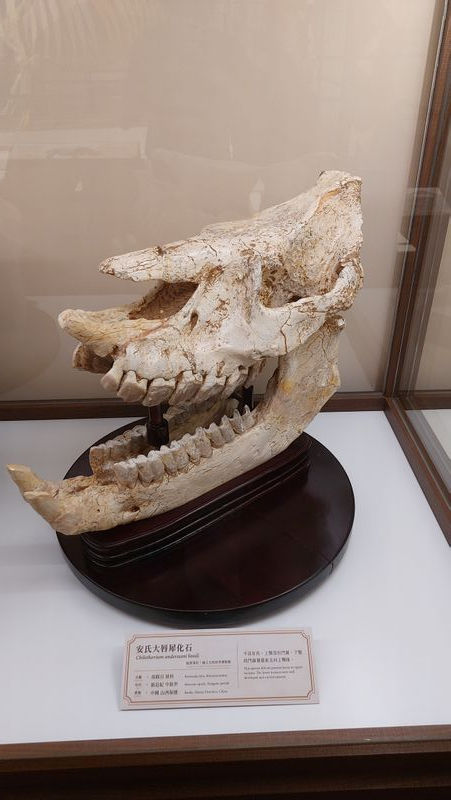
Chilotherium anderssoni belongs to the hornless rhinocerotid subfamily Aceratheriinae, and its skeletal structure broadly resembles that of typical rhinoceroses. However, it lacks the nasal rugosities that in living rhinoceroses serve as the attachment base for a keratinous horn. In other words, the nasal bones do not show the roughened surface associated with horn support, leading paleontologists to infer that this species did not possess a horn.
Compared with modern rhinoceroses, Chilotherium anderssoni was proportionally somewhat more compact. Its shoulder height is estimated at approximately 1.5–1.8 meters, with a body mass ranging from about 1 to 2.5 tonnes. Each limb bore three toes. The lower jaw is more protrusive than the upper jaw, and it carries a pair of enlarged incisor tusks, while the upper jaw lacks incisors. The dental formula is 0.0.3.3 / 1(2).0.3.3. These enlarged lower incisors correspond to the tusk-like i2 described in the fossil material .
Etymology
The genus name is derived from the Ancient Greek cheílos (χείλος), meaning 'lip', combined with theríon (θηρίον), meaning 'beast'.
The species name anderssoni honors Dr. Andersson.
Biological description
The Chilotherium lineage likely originated in the Siwalik region of South Asia. The earliest representatives appeared during the late Miocene and subsequently dispersed across much of Eurasia under relatively humid climatic conditions.
Ecologically, Chilotherium anderssoni was a grazing herbivore inhabiting low-lying wetland environments. Its distribution pattern suggests seasonal movement, likely tracking shifts in water availability and vegetation.
By the early Pliocene, Chilotherium anderssoni declined and was replaced by horned rhinocerotids of African origin. This transition is plausibly linked to environmental change: increasing aridity and the expansion of tougher, silica-rich grasses would have favored taxa better adapted to grazing under such conditions.
(Author: Rodrigo)
Reference
Chen, Shaokun; Deng, Tao; Hou, Sukuan; Shi, Qinqin; Pang, Libo (2010). "Sexual dimorphism in perissodactyl rhinocerotid Chilotherium wimani from the late Miocene of the Linxia Basin (Gansu, China)" . Acta Palaeontologica Polonica. 55 (4): 587–97. doi:10.4202/app.2009.0001
37.52, 112.33


Comments