
Egypt's First Confirmed Pterosaur Fossil Fills a Cretaceous Gap in Northeastern Africa

Cretaceous pterosaur fossils have been discovered in Morocco, Tunisia, Lebanon, and Jordan, yet Egypt, situated between these regions, had long lacked any confirmed record of the group. That gap has now been filled by a single wing phalanx. A three-dimensionally preserved pterosaur bone, catalogued as MUVP 507, was discovered in the Bahariya Oasis of Egypt's Western Desert. The specimen is extensively ferruginized, giving its surface a dark reddish-brown coloration, and comes from the lower Cenomanian Bahariya Formation of the Late Cretaceous. Although the fossil consists of only a single bone, its articular morphology, cortical thickness, and proportions indicate that it most likely belonged to an ornithocheiriform pterosaur (Ornithocheiriformes) with a wingspan of approximately 4 m. It represents the first confirmed pterosaur fossil record from both Egypt and northeastern Africa.

MUVP 507 is the first phalanx of the fourth digit of the left wing, also known as the first wing phalanx or manual phalanx IV-1. In pterosaurs, the fourth digit was greatly elongated and formed the principal skeletal support for the wing membrane, making this bone a major structural component of the wing. The specimen measures 43.25 cm in length and approximately 6.63 cm across its widest proximal portion. The shaft narrows considerably toward the middle, where the cortical bone is only about 0.9–1 mm thick. The fossil was discovered in 2018 by a team from the Mansoura University Vertebrate Paleontology Center near Gebel El Dist in the northern part of the Bahariya Oasis. It had already broken into four pieces when found, but the fragments were scattered within an area of only about one square metre, and their broken surfaces fitted together precisely. After preparation, the researchers reassembled the four fragments and used three-dimensional laser scanning to reconstruct the complete morphology of the bone.

How much taxonomic information can a single wing phalanx provide? Much of the answer lies at the two ends of the bone, particularly the proximal end nearest the hand. The proximal end of the first wing phalanx bears a structure known as the extensor tendon process. In MUVP 507, this process is fused to the phalanx, although a faint suture remains visible. This indicates that the individual had reached osteological maturity by the time it died.
Viewed dorsally or ventrally, the extensor tendon process of MUVP 507 has a roughly trapezoidal outline, and the proximal part of the bone also bears a prominent pneumatic foramen. The relative proportions of the articular surfaces, the morphology of the distal end, and the sub-oval to sub-triangular cross-section of the shaft are likewise more consistent with ornithocheiriform anatomy. The researchers compared the specimen with Anhanguera piscator from Brazil, Ferrodraco lentoni from Australia, and the indeterminate ornithocheiriform specimen AMNH 22552, all of which possess comparable features in the first wing phalanx.

Azhdarchoids (Azhdarchoidea) represent another possibility, as members of this group are also known from the Late Cretaceous of North Africa and the Arabian Peninsula. Their first wing phalanges, however, are generally more elongate and gracile, and the morphology of the extensor tendon process and proximal articular surfaces differs from that of MUVP 507. In azhdarchids (Azhdarchidae), for example, the dorsal cotyle typically occupies a larger proportion of the proximal articulation. The relatively robust proportions and articular morphology of MUVP 507 therefore remain more consistent with Ornithocheiriformes.
The thin cortical walls and pneumatic openings require more cautious interpretation. At the midshaft of MUVP 507, cortical bone accounts for only a small proportion of the total cross-sectional area. The bone is hollow internally, and a conspicuous pneumatic foramen is present near the proximal end, features consistent with the lightweight skeletal construction seen in many pterosaurs. Similar features, however, also occur in other pterosaur lineages, so the researchers did not treat them as diagnostic characters on their own. Because no skull, rostrum, or teeth were preserved, the specimen could not be assigned more precisely to Anhangueridae or Ornithocheiridae. Its most conservative identification therefore remains an indeterminate ornithocheiriform.

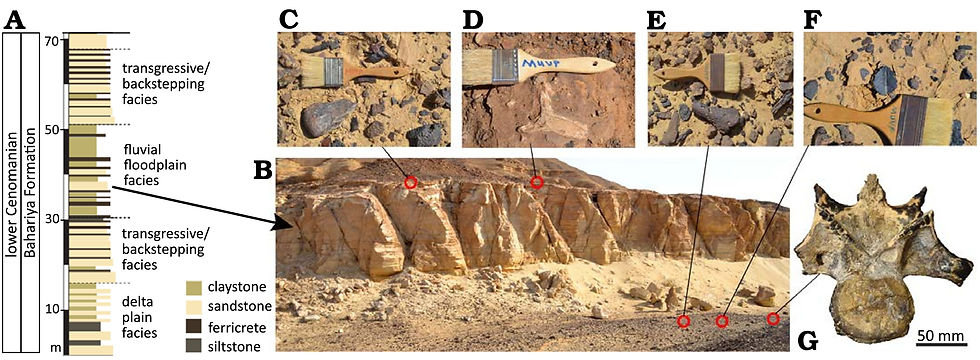
The Bahariya Formation was deposited across a low-lying landscape influenced by both fluvial and coastal processes, including river floodplains, lagoons, tidal flats, and channels. MUVP 507 came from locality BOV16-10, which represents a fluvial floodplain setting. The same locality has also yielded fishes, non-avian dinosaurs, plant leaves, and a previously described cervical vertebra belonging to an abelisaurid theropod. The fauna of the Bahariya Formation shares considerable similarities with that of the approximately coeval Kem Kem Group of Morocco. The latter has already produced an exceptionally rich pterosaur assemblage comprising at least ten taxa, making the long-standing absence of confirmed pterosaurs from Egypt particularly conspicuous.
MUVP 507 does not establish a new species of pterosaur, nor does it preserve a skull that would allow its appearance to be reconstructed in detail. Its significance lies elsewhere. Fossils from Morocco, Algeria, Tunisia, and the Levant have already shown that several distinct pterosaur lineages inhabited the southern margin of the Tethys around the Cenomanian. With the discovery of MUVP 507, Egypt can now be added to that palaeogeographic distribution.
Author: Shui-Ye You
Reference:
Salem BS et al. (2026). The first pterosaur fossil from Egypt. Acta Palaeontologica Polonica.


Comments