
Globidens alabamaensis

Updated: Apr 9

Age
Cretaceous(Campanian)
84.9-66 Ma
Taxonomy
Kingdom: Animalia
Phylum: Chordata
Class: Reptilia
Order: Squamata
Family: Mosasauridae
Genus: Globidens
Species: Globidens alabamaensis
Morphological description
Globidens alabamaensis is a medium-sized mosasaur, reaching approximately 6 meters in length, with a streamlined body and a laterally flattened tail. Its most distinctive features are the robust skull and highly specialized dentition. This marine reptile possessed globular teeth and a thickened lower jaw, adaptations suited for crushing hard prey.
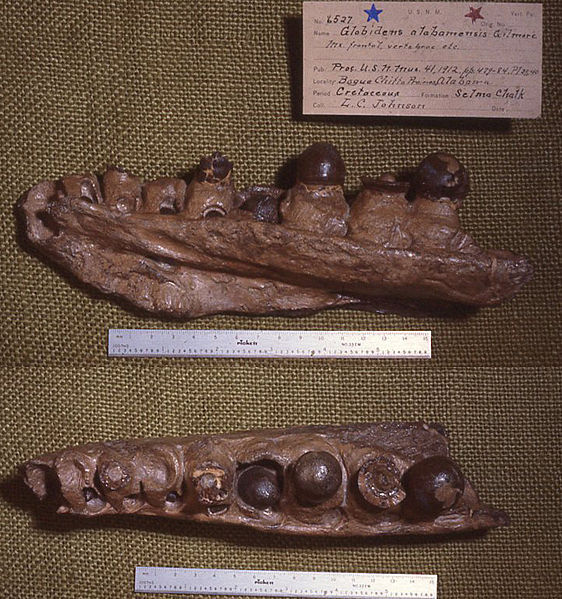
The earliest known fossil record is the holotype specimen (USNM 6527) described in 1912, consisting of an incomplete maxilla. This specimen reveals heterodont dentition within the maxilla, where the anterior teeth are taller and cylindrical, while the posterior teeth are hemispherical. Subsequent studies indicate that the maxilla likely bore approximately 13 teeth. This differs among species within the genus: Globidens dakotensis has 13 maxillary teeth, G. schurmanni has 11, and G. phosphaticus has 10.

A newly discovered specimen (CTC 01) from the North Sulphur River in Texas includes a pair of complete maxillae, each preserving 12 tooth positions. In the left maxilla, the crowns of the third, fourth, sixth, eighth, tenth, and eleventh teeth are well preserved, while in the right maxilla, crowns are preserved from the second through the thirteenth positions.
The first three tooth positions bear tall, cylindrical crowns with posteriorly inclined apices. From the fourth to the thirteenth positions, the crowns become subspherical in shape. Tooth size generally increases from the first through the tenth positions, while the eleventh to thirteenth crowns are low-domed and noticeably shorter.
All teeth are covered with coarse, anastomosing enamel. The enamel texture is thicker and more wrinkled near the apex, gradually thinning toward the base until the basal portion becomes smooth. Each tooth possesses minute carinae oriented anteroposteriorly, but these lack serrations or crenulations. The basal cross-section of the crowns is circular, and there is no constriction between crown and root.
On the medial surface of the left maxilla, replacement pits are present at the fourth, sixth, and seventh tooth positions. A developing tooth within the seventh alveolus is approximately equal in size to a fully erupted tooth.
The maxillae are overall robust and massive, resembling those of large prognathodontine mosasaurs. A dorsal emargination is present above the fifth tooth position, although the outer cortical surface is eroded, obscuring the neurovascular foramina.
The specimen also includes two isolated rooted teeth, likely originating from the mid-region of the dentary, further demonstrating dental heterogeneity. Compared with other species, the crushing teeth of G. alabamaensis exhibit a characteristic subspherical morphology. They are taller and narrower than those of G. dakotensis, lack the symmetrical bell-shaped crowns seen in G. schurmanni, and do not show the posterior buttressing or grooves characteristic of G. phosphaticus.
The ventral margin of the maxilla is straight, a feature shared across all species of Globidens. These morphological traits collectively reinforce the identification of this species as a representative member of the genus Globidens.
Etymology
The species name Globidens alabamaensis reflects both its geographic origin and its distinctive dentition. It was named by Charles Whitney Gilmore in 1912. The genus name Globidens derives from the Latin globus (sphere) and dens (tooth), referring to the rounded, globular shape of its teeth, which are adapted for crushing hard prey. The species name alabamaensis refers to Alabama, where the holotype specimen was discovered in early to middle Campanian deposits, emphasizing its geographic provenance.
Biological description
As a Late Cretaceous durophagous marine reptile, Globidens alabamaensis exhibited ecological specialization toward feeding on hard-shelled benthic organisms. Its hemispherical teeth and heavily built jaws were well suited for crushing prey such as oysters and other shelled invertebrates. This durophagous feeding strategy is interpreted as an adaptation for exploiting benthic bivalves associated with coral and rudist reef environments during the Late Cretaceous.
References
LeBlanc, A. R. H., Mohr, S. R., & Caldwell, M. W. (2019). Insights into the anatomy and functional morphology of durophagous mosasaurines (Squamata: Mosasauridae) from a new species of Globidens from Morocco. Zoological Journal of the Linnean Society, zly008. https://doi.org/10.1093/zoolinnean/zly008
Rempert, T. H., Martens, B. P., Vinkeles Melchers, A. P. M., & Rempert, A. N. (2024). New remains of the mosasaur Globidens alabamaensis from the North Sulphur River of Texas. The Journal of Paleontological Sciences, JPS.C.24.0001, 1-7.
32.7, -86.7


Comments