
Longisquama insignis

Updated: Apr 10
Age
Triassic(Ladinian-Carnian)
242-228 Ma
Taxonomy
Kingdom: Animalia
Phylum: Chordata
Class: Sauropsida
Subclass: Diapsida
Clade: Drepanosauromorpha
Family: Longisquamidae
Genus: Longisquama
Species: Longisquama insignis
Morphological description
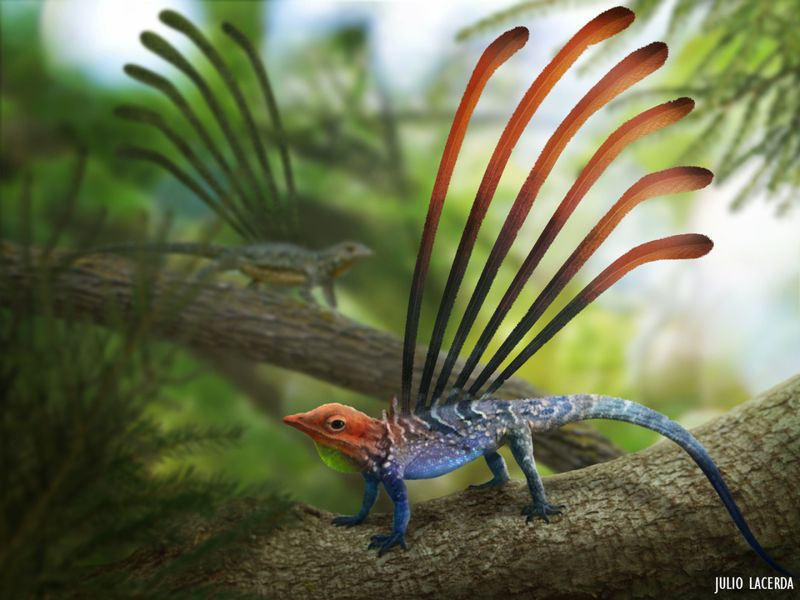
The most distinctive feature of Longisquama insignis is a series of seven elongated integumentary appendages attached along its back. These structures are arranged in a fan-like pattern, originating from the dorsal region of the thoracic vertebrae and extending posteriorly, with lengths ranging from approximately 7.6 cm to 14.2 cm, slanting backward as they spread.
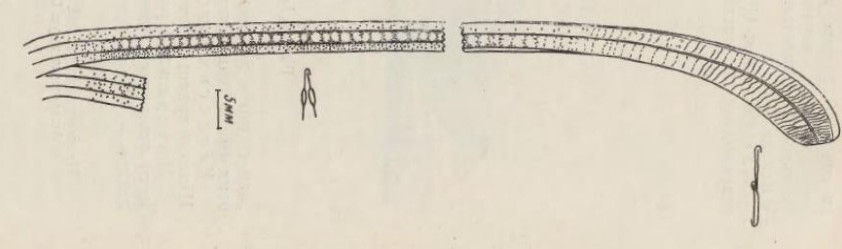
Each appendage exhibits a hockey-stick-like shape. The proximal section near the base is long and narrow, whereas the distal portion is broader and curves posteriorly. The proximal region can be subdivided longitudinally into three parts: an anterior lobe, a middle lobe, and a posterior lobe. Among these, the middle lobe is the widest and bears a distinctive corrugated surface, with folds arranged in a bead-like pattern, forming oval to rectangular ridges. The distal portion is asymmetrically bipartite, consisting of anterior and posterior lobes with pronounced transverse corrugations, separated by a distinct axial structure.
Skeletal remains indicate that Longisquama insignis was a small diapsid reptile with an elongated trunk, relatively long neck, and slender tail. Excluding the tail, the body length is about 5 cm, with a skull length of approximately 2.3 cm. The orbits are large and contain a broad sclerotic ring. Although the skull is incompletely preserved, two temporal fenestrae and a small antorbital opening can be identified. The posterior part of the mandible includes an opening, and the teeth are small, conical, and acrodont. The maxilla bears 12–13 tooth pairs, while the mandible carries 16–17 pairs.
The cervical series comprises no more than seven vertebrae, lacking cervical ribs. Each cervical vertebra is about 1 cm long, and the thoracic vertebrae are approximately 3.5 mm in height. The scapula is slender and slightly expanded distally, measuring about 1.2 cm in length. The clavicles are curved and fused medially, forming a structure together with the well-developed interclavicle (about 9 mm long) that resembles the furcula of birds. The humerus is about 1.3 cm long, and the forearm—composed of the radius and ulna of similar size and shape—is approximately 1.1 cm long. The manus is equal in length to the forearm. The phalangeal proportions are unusual: in the fourth digit, the first, second, and fourth phalanges are of equal length, while the third is shorter. There is no evidence of skeletal pneumatization.
In some specimens, the proximal bases of the appendages are closely associated with the neural spines of the thoracic vertebrae, suggesting that they were deeply anchored within the dermis and likely supported by ligaments or muscles. Compared with dorsal crests or ornamental scales in extant reptiles, these appendages are markedly more elongated and exhibit a higher degree of structural differentiation .
The holotype specimen is catalogued as PIN 2584/4.

Etymology
The genus name Longisquama derives from Latin: "longi-" meaning long, and "squama" meaning scale, referring to its elongated scale-like structures.
The species name insignis means remarkable or distinctive, highlighting its unusual morphology.
Biological description
Longisquama insignis is a diapsid reptile that lived during the Middle to Late Triassic (Ladinian to Carnian stages, approximately 242–228 million years ago). Its fossils were discovered in lacustrine deposits of the Madygen Formation in present-day Kyrgyzstan, specifically at the Sharov locality, a site known for exceptional preservation of soft tissue impressions .
The holotype specimen PIN 2584/4 preserves seven elongated integumentary appendages extending from the dorsal region of the thorax. These structures are clearly associated with the skin and have historically been interpreted by some researchers as feather-like due to their corrugated surfaces and features resembling a central axis and branching elements. However, subsequent analyses suggest that although they share certain morphological similarities with feathers, these similarities likely arose through convergent evolution rather than true homology. They are therefore not considered genuine feathers or direct precursors of advanced feather structures .
Functionally, these appendages were unlikely to have played a role in flight. Instead, they are more plausibly interpreted as display structures, potentially used in courtship or social signaling, analogous to the dorsal crests seen in certain extant lizards. It has been proposed that these appendages may have been mobile, capable of being erected or folded through muscular action, forming a dynamic display fan.
(Author: Shui-Ye You)
References
Sharov AG. (1970). A peculiar reptile from the lower Triassic of Fergana. Paleontologiceskij Zurnal.
Buchwitz M and Voigt S. (2012). The dorsal appendages of the Triassic reptile Longisquama insignis: reconsideration of a controversial integument type. Paläontol Z.
40.06, 70.18


Comments