
Nigersaurus taqueti

Updated: Apr 9

Age
Cretaceous(Aptian-Albian)
115-105 Ma
Taxonomy
Kingdom: Animalia
Phylum: Chordata
Class: Sauropsida
Order: Saurischia
Family: Rebbachisauridae
Genus: Nigersaurus
Species: Nigersaurus taqueti
Morphological description
In the Elrhaz Formation of Niger, within the Sahara Desert, paleontologists discovered the fossil of an exceptionally lightweight sauropod dinosaur. This animal, Nigersaurus taqueti, possessed an extraordinarily delicate skull, with nearly the entire cranium constructed from paper-thin bony plates. The total cross-sectional area of bone connecting the muzzle to the occipital region is only about 1 cm², and most of these bony struts are less than 2 mm thick .
The skull exhibits several unusual openings, including a closed supratemporal opening and the reappearance of an external mandibular fenestra in the lower jaw, along with additional rare fenestrae not commonly seen in other sauropods .
At the anterior ends of both upper and lower jaws lies a transversely expanded tooth battery. Each side of the upper jaw contains approximately 29 teeth, while each side of the lower jaw has about 34 teeth, resulting in a total exceeding 500 teeth when replacement teeth are included. The teeth are slender and columnar, with strongly asymmetrical enamel that is about ten times thicker on the labial side than on the lingual side . Wear facets on the teeth demonstrate a vertical shearing motion (orthal jaw stroke), rather than a fore-aft sliding motion. Tooth replacement occurred extremely rapidly, with each tooth being replaced approximately once per month, nearly twice the rate observed in hadrosaurids.

Endocasts of the cranial cavity indicate a total brain volume of about 53.4 cm³, with very small olfactory bulbs, suggesting that olfaction was not a dominant sensory modality. The structure of the inner ear reveals that the head was habitually oriented downward, with the muzzle directed toward the ground.
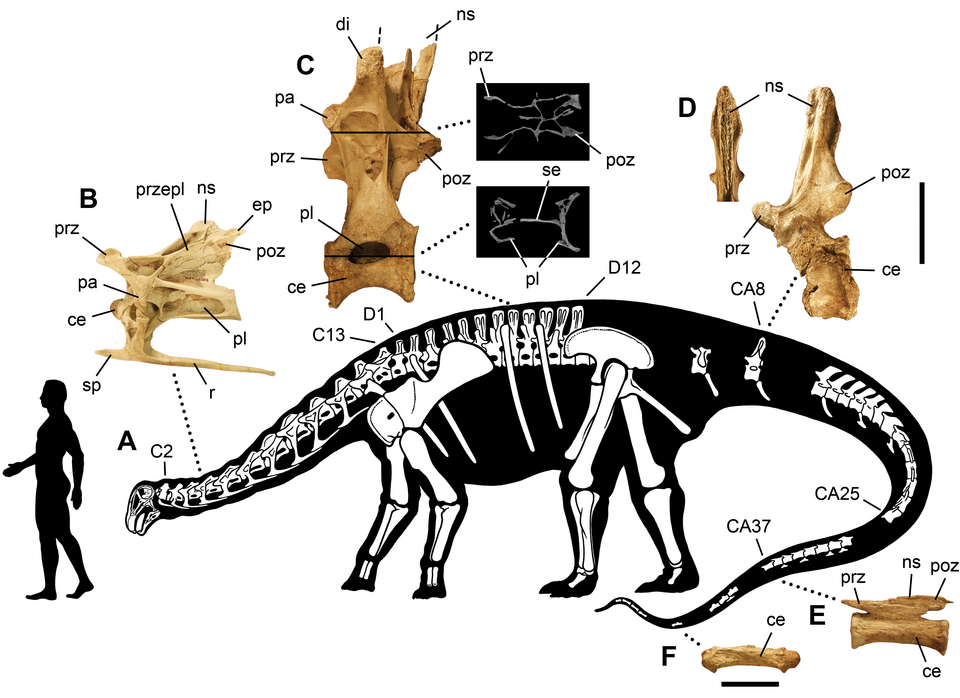
The cervical series consists of only 13 vertebrae and is relatively short, approximately 130% the length of the dorsal series. The vertebrae are highly pneumatic, with internal air spaces exceeding bone volume, producing an extremely lightweight axial skeleton. The total body length is about 9 meters, with a femur length of roughly 1 meter, and an estimated body mass of around 4 tons, comparable to that of a modern elephant.
Etymology
The genus name Nigersaurus combines "Niger", referring to the country where the fossils were discovered, with the Greek word sauros (σαῦρος), meaning "lizard", forming the meaning "lizard of Niger".
The species name taqueti honors the French paleontologist Philippe Taquet, who first discovered fossils of this taxon in Niger during the 1970s.
Biological description
Nigersaurus taqueti represents an extreme adaptation to ground-level feeding. Its downward-oriented head and broad, squared muzzle enabled efficient cropping of vegetation close to the ground. Dental wear patterns indicate that it primarily consumed relatively soft plants, likely including ferns and horsetails, rather than tougher vegetation.
Its bite force was relatively weak, and its dentition was specialized for slicing rather than crushing. In ecological terms, Nigersaurus taqueti functioned as a Mesozoic analogue of grazing herbivores, occupying a role similar to that of modern ungulates such as antelope or cattle, continuously feeding on low-growing vegetation.
The skeleton indicates a lightweight body construction, with limb proportions similar to other diplodocoid sauropods, where the forelimbs are approximately two-thirds the length of the hind limbs . Pneumatic invasion of the vertebrae greatly reduced skeletal mass, reflecting an avian-like respiratory system with extensive air sacs.
Within its ecosystem, Nigersaurus taqueti coexisted with other large herbivores such as the iguanodontian Lurdusaurus, together forming the dominant megaherbivore assemblage of the inland floodplains of Cretaceous Niger. Its feeding strategy likely exerted sustained pressure on ground-level vegetation, shaping plant communities over long timescales.
(Author: Rodrigo)
Reference
Sereno, P. C., Wilson, J. A., Witmer, L. M., Whitlock, J. A., Maga, A., Ide, O., & Rowe, T. A. (2007). Structural extremes in a Cretaceous dinosaur. PLoS ONE, 2(11), e1230. https://doi.org/10.1371/journal.pone.0001230
16.8, 9.5


Comments