
Palaeocharinus rhyniensis

Updated: Apr 10
Age
Devonian(Lochkovian-Pragian)
411-408 Ma
Taxonomy
Kingdom: Animalia
Phylum: Arthropoda
Class: Arachnida
Order: Trigonotarbida
Family: Palaeocharinidae
Genus: Palaeocharinus
Species: Palaeocharinus rhyniensis
Morphological description
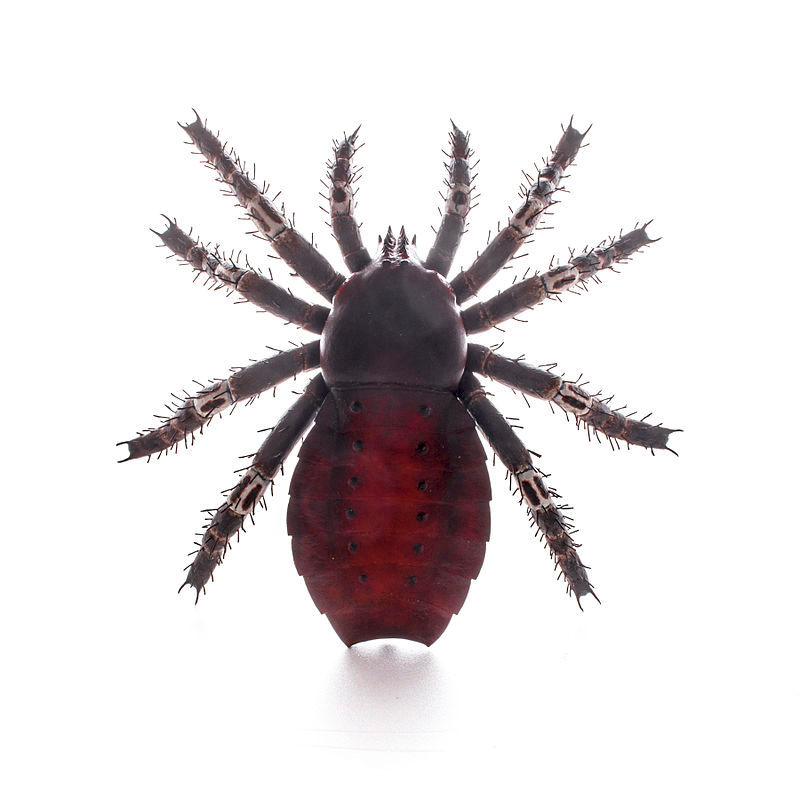
In thin sections of silicified deposits from the Rhynie locality, individuals of Palaeocharinus rhyniensis are most commonly preserved in a flexed body posture. The prosoma is elevated and extends anteriorly into a rostral projection. The carapace bears a distinct median ocular tubercle centrally, while paired lateral ocular tubercles form rounded prominences on either side. These lateral tubercles preserve multiple lenses, including a large lower ocellus and two relatively larger upper ocelli, accompanied by numerous smaller lens elements. This arrangement suggests an intermediate condition between compound eyes and simple ocelli.

The chelicerae, located on either side of the rostrum, extend downward from the anterior margin of the prosoma. They are robust at the base, with terminal fang-like elements that curve downward and slightly posteriorly. This morphology indicates a predatory strategy involving short-range capture and mechanical piercing at or near the substrate surface. Thin-section material and three-dimensional reconstructions released by the University of Aberdeen further reveal that the carapace is dome-shaped, and the rostrum bears paired rows of granular ridges extending to the anterior tip—features characteristic of the genus Palaeocharinus.

The opisthosoma exhibits clear transverse tergites and is longitudinally differentiated into a median band and lateral regions, rather than forming a fused unit as in modern spiders. The posterior end terminates in a small anal tubercle. Internally, a pair of well-preserved lamellate book lungs is visible; their stacked plate-like structures are clearly distinguishable in thin sections, confirming full terrestrial adaptation and air-breathing capability.
The appendages consist of four pairs of walking legs, each preserving a complete segmentation sequence: coxa, trochanter, femur, patella, tibia, metatarsus, and tarsus. The distal tarsus bears paired claws, and the terminal segments are densely covered with setae, which likely functioned in both mechanosensory and chemosensory roles. Although the legs of Palaeocharinus rhyniensis lack the dense tuberculate ornamentation seen in trigonotarbid species from the nearby Windyfield locality, their exoskeleton still displays scale-like ornamentation, a feature of taxonomic significance within Trigonotarbida.

X-ray tomography and three-dimensional reconstruction studies indicate that the chelicerae conform to a paleognathic type: the paired chelae are arranged nearly parallel and close downward, rather than forming the crossing, scissor-like configuration typical of most modern spiders. The mouth opening is slit-like, bordered by a labrum and labium. Within the oral cavity, bundles of setae or small plate-like structures are inferred, possibly forming a filtering apparatus. This is consistent with a feeding strategy involving extra-oral digestion, in which prey tissues are liquefied externally before ingestion. These functional interpretations are supported by multiple recent studies combining imaging, comparative morphology, and phylogenetic reconstruction.
Etymology
The genus name Palaeocharinus derives from the Greek palaios (παλαιός, "ancient"), Latinized as the prefix palaeo-, combined with Charinus, a modern genus of whip spiders (Amblypygi) named by Eugène Simon in 1892. The name may thus be interpreted as "ancient Charinus", reflecting perceived morphological similarities between the fossil and extant forms.
The species epithet rhyniensis is a toponymic adjective derived from the locality Rhynie in Scotland, combined with the Latin suffix -ensis, meaning "from" or "originating in". It denotes that the species was discovered in the Rhynie area, a well-known Early Devonian fossil locality.
Biological description
In the Early Devonian wetland environment of Rhynie, Palaeocharinus rhyniensis measured approximately 3–4 cm in body length and can be interpreted as a small, agile, surface-dwelling predatory arthropod. It lacked spinnerets and therefore had no capacity for silk production. The tarsal segments bear well-developed paired claws and are densely covered with sensory setae, suggesting adaptation for locomotion, attachment, and detection of substrate vibrations on silicified plant debris and consolidated surfaces. The downward-directed chelicerae and robust appendages indicate a predatory strategy based on ambush, likely involving short-distance strikes among ground-level vegetation.
Some specimens have been found preserved within hollow plant stems or sporangial cavities, suggesting that these microhabitats may have served as shelters, refuges, or molting sites. The presence of well-preserved book lungs provides clear evidence of a fully terrestrial lifestyle dependent on air respiration. Recent morphological and taxonomic studies further indicate that among the multiple species historically assigned to Palaeocharinus from the Rhynie chert, only a few—including P. rhyniensis—are considered valid, while many others are now interpreted as artifacts of preservation or morphological variation.
With respect to feeding ecology, there is no evidence supporting the presence of venom gland openings. This suggests that trigonotarbids, including Palaeocharinus rhyniensis, lacked venom injection capabilities. Instead, they likely relied on mechanical piercing and grasping to damage prey tissues, followed by extra-oral digestion and subsequent uptake of liquefied nutrients via an oral filtering apparatus. This interpretation is consistent with the fine structure of the mouthparts, the functional morphology of the chelicerae, and ecological parallels with modern harvestmen (Opiliones), which do not construct webs and actively forage on the substrate.
Author: Rodrigo
References
Dunlop, J. A. (2017). Terrestrial invertebrates in the Rhynie chert ecosystem. Philosophical Transactions of the Royal Society B, 373(1739), 20160493.https://doi.org/10.1098/rstb.2016.0493
Garwood, R. J., & Dunlop, J. A. (2014). The walking dead: Blender as a tool for paleontologists with a case study on extinct arachnids. Journal of Paleontology, 88(4), 735–746.
University of Aberdeen, School of Geosciences. (n.d.). Trigonotarbid arachnids — Rhynie Chert Learning Resource.
Garwood, R. J., et al. (2014). A volumetric approach to trigonotarbid arachnids. PeerJ, 2, e641.
Garwood, R. J., & Dunlop, J. A. (2020). An introduction to the Rhynie chert. Geological Magazine, 157(1), 47–72.
57.33, -2.83


Comments