
The Dangerous Sweetness – The Evolution and Domestication of Bees (Part I)

Updated: Apr 10
Buzz! Buzz! Everyone busy at work! As spring arrives and flowers bloom across the landscape, the air fills with the movement of hardworking bees. Bees are perhaps one of the most familiar insects associated with spring; almost everyone recognizes these industrious little creatures. Yet how much do we truly understand about them? Where did bees originate, and how did humans eventually domesticate them? Let us take a closer look at the story behind these remarkable insects.

Bees of the genus Apis belong to the order Hymenoptera and the family Apidae. The type species of this genus is the Western honey bee, Apis mellifera. Within Apis, three subgenera are generally recognized: the giant honey bees, the dwarf honey bees, and the typical honey bees. The last of these includes the species most familiar to people today, such as the Eastern honey bee (Apis cerana), the Western honey bee (Apis mellifera), the Sabah honey bee (Apis koschevnikovi), and the Sulawesi honey bee (Apis nigrocincta).

Like several other members of Hymenoptera, honey bees are eusocial insects. The concept of eusociality was formally introduced in 1966 by the ecologist Suzanne Batra to describe animals with highly organized social systems. Eusocial organisms must possess three defining characteristics: reproductive division of labor, overlapping generations within a colony, and cooperative care of the young. In simple terms, this means that a colony contains specialized reproductive individuals—such as queens—while their offspring remain in the nest and assist in raising younger siblings.

Within a honey bee colony, individuals fall into three principal castes: workers, drones, and the queen. These castes differ markedly in both form and function. Drones are the colony's only haploid individuals, meaning they possess a single set of chromosomes. Their body shape resembles that of workers, but their compound eyes are significantly larger, their mouthparts are shorter, and they possess three ocelli on the head. These features help drones locate queens during mating flights.

Workers and queens, in contrast, are both diploid females from a genetic perspective. However, the queen is dramatically larger than workers and has a much longer lifespan. While workers typically live between thirty and sixty days and drones survive for roughly one to three months, a queen may live for five to six years.

Workers also differ from queens in several important anatomical features. Their bodies possess specialized structures adapted for the many demanding tasks required to maintain the colony.

One of the most obvious adaptations involves the mouthparts. In worker bees these are modified into a long, tongue-like structure that allows them to collect nectar and perform cleaning activities within the hive. Their hind legs also differ from those of the queen. To facilitate pollen collection, the hind legs of workers are equipped with specialized pollen baskets that allow them to transport pollen efficiently. Workers also play a defensive role within the colony. In doing so they sacrifice their reproductive capacity: their ovipositor has been transformed into a stinger connected to a venom gland, enabling them to defend the hive against predators seeking honey or larvae.


What, then, determines the dramatic differences between workers and queens? The answer lies partly in the life history of honey bees.
Like most insects that undergo complete metamorphosis, honey bees pass through four developmental stages: egg, larva, pupa, and adult. After the queen lays eggs, the responsibility for rearing the young is taken over by worker bees. During the first three days of larval development, workers feed all larvae with a special secretion produced by glands in their heads, commonly known as royal jelly. This nutrient-rich substance contains hormones, amino acids, and vitamins that stimulate rapid growth and can direct a larva to develop into a queen.
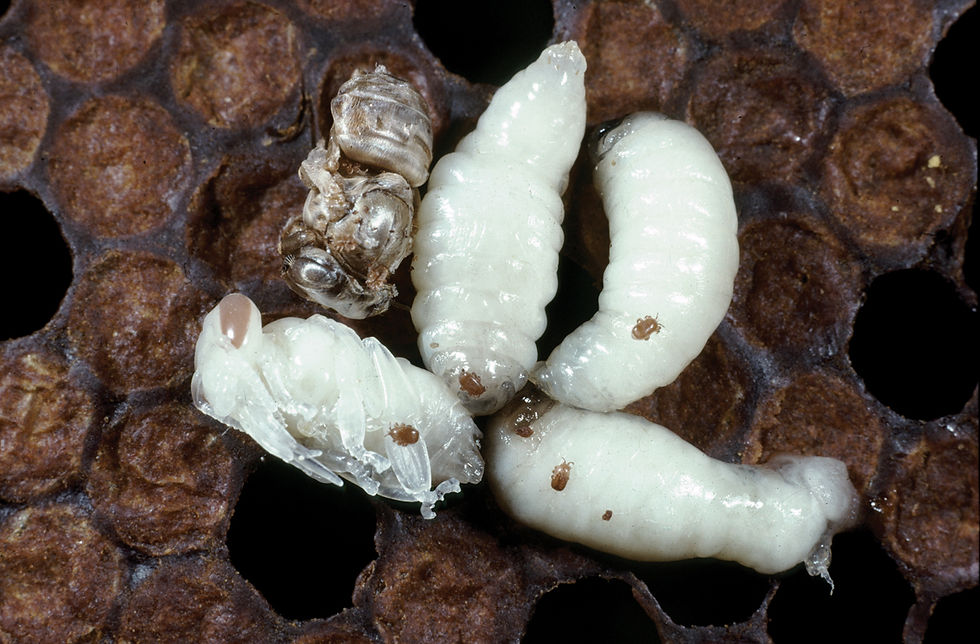
To prevent the emergence of too many queens within a single colony, worker bees alter the diet of most larvae beginning on the fourth day. Instead of royal jelly, these larvae—destined to become workers or drones—are fed a mixture of pollen and honey. Only larvae housed in special queen cells continue to receive royal jelly throughout development.
After approximately four days of feeding on pollen and honey, the larvae spin silk and seal the cell entrance before entering the pupal stage. Roughly twelve days later a fully developed worker emerges.
As in many eusocial insects, newly emerged workers immediately begin performing tasks within the colony. Their first role is that of a nurse bee, feeding larvae and cleaning the hive. This phase usually lasts around ten days. Afterward, their wax glands and venom glands have matured, and the bees transition into builder bees. At this stage their duties include constructing comb, defending the hive, and removing dead individuals. During periods of food scarcity—particularly in winter—they may also expel idle drones from the colony.
After about two weeks of performing these tasks, the wax glands begin to degenerate. The workers then transition into foragers, leaving the hive to gather nectar and pollen and to scout for food sources. This stage is the most dangerous part of a worker bee's life and is typically its final role; workers continue foraging until the end of their lives.

When did bees first appear? To understand the origin of bees, one must begin with the origin of Hymenoptera itself.
The earliest known hymenopteran fossils date back to the Triassic and belong to the superfamily Xyeloidea. These insects superficially resemble modern bees in possessing membranous wings that fold backward and large compound eyes. However, they differed in several important respects. Their abdomens were broader, their ovipositors were serrated, their wing venation was more complex, and their hind wings lacked hamuli—the tiny hooks that link the hind wings to the forewings in more derived hymenopterans. Their mouthparts were adapted for chewing.
These primitive hymenopterans likely lived in a manner similar to their descendants in the suborder Symphyta. Using their serrated ovipositors, they could cut into plant tissues and deposit eggs inside. This strategy allowed larvae to feed immediately on plant material after hatching while remaining concealed from predators.

During the Early Cretaceous, some members of Hymenoptera shifted their reproductive strategy. Instead of laying eggs within plants, they began hunting other insects and depositing their eggs directly inside the prey. This shift required a transformation of the ovipositor, which evolved from a saw-like structure into a sharp needle capable of penetrating animal tissue. At the same time, the body segments between the thorax and abdomen became narrower and more flexible. These anatomical changes marked the emergence of the suborder Apocrita—the group characterized by a constricted “wasp waist.”

As evolution continued, Apocrita diverged into two major lineages. One lineage developed extremely long ovipositors and sophisticated parasitic strategies, eventually giving rise to the parasitic wasps. The other lineage, known as the Aculeata, adopted a different approach. Rather than relying on parasitism, these wasps became active hunters. Through natural selection they evolved potent venoms and the ability to construct nests or storage chambers in which prey could be placed as food for developing larvae.

By the middle to late Cretaceous, flowering plants had begun to diversify dramatically, an event often referred to as the Cretaceous Terrestrial Revolution. As angiosperms spread across terrestrial ecosystems, many insects evolved to feed on pollen and nectar. Hymenopterans were among those that took advantage of this ecological opportunity. During this period, certain aculeate lineages abandoned insect hunting and instead began collecting pollen and nectar, storing these resources in mud nests to provision their offspring. These insects represent the earliest bees.

Over long evolutionary timescales, these early bees diversified not only in diet but also in behavior. Some species continued the solitary lifestyle of their ancestors, while others began exhibiting increasing degrees of social cooperation. In certain species, adult offspring remained in the nest and helped their mother care for younger siblings. Gradually, varying levels of social organization emerged. Some bees formed loose aggregations with limited cooperation, such as halictine bees. Others retained a solitary lifestyle, such as leafcutter bees. Still others evolved highly organized social systems with caste divisions, as seen in bumblebees and honey bees.

The evolutionary origin of eusocial behavior remains a topic of ongoing research. Similar forms of social organization have arisen independently multiple times within Hymenoptera. Ants, for example, evolved from another lineage of ground-dwelling solitary wasps, yet they developed eusocial systems independently of bees and wasps. Current research suggests that such social behavior may be associated with specific neural receptor genes, although additional evidence is still needed to fully understand its origins.
Among the many bee lineages, the genus Apis appears relatively late in the evolutionary record. The earliest fossils attributed to honey bees come from European deposits dating to the boundary between the Eocene and Oligocene epochs. Molecular evidence, however, suggests that the genus likely originated in South Asia before spreading during the late Eocene into Eurasia, Africa, and eventually the Americas.
Subsequent climatic changes—including the expansion of ice ages and the uplift of the Himalayas—isolated populations across different continents. Over time these separated populations diverged into the distinct lineages we recognize today: the dwarf honey bees, the giant honey bees, and the typical honey bees.
(To be continued)

Author: Rodrigo
Reference:
James L. Gould; Carol Grant Gould (1995). The Honey Bee. Scientific American Library. p. 19.
Batra, Suzanne W. T. (1 September 1966). "Nests and Social Behavior of Halictine bees of India (Hymenoptera: Halictidae)". The Indian Journal of Entomology.
Robert E. Snodgrass (1984). Anatomy of the Honey Bee. Cornell University Press. p. vii.
Engel, M. S. (2001). A Monograph of the Baltic Amber Bees and Evolution of the Apoidea. Bulletin of the American Museum of Natural History.
Danforth, B. N. et al. (2013). The Impact of Molecular Data on Our Understanding of Bee Phylogeny and Evolution.
Bossert, S. et al. (2019). Phylogenomic Insights into the Evolution of Bees. Current Biology, 29(2).
Cardinal, S. & Danforth, B. N. (2013). Bees Diversified in the Shadow of Angiosperms. Proceedings of the Royal Society B.


Comments