
The Protruding-Jawed Rhinoceros – Chilotherium

Updated: Apr 10
Does a rhinoceros necessarily need a sharp horn on its nose? If a rhinoceros lacks that iconic spike, can it still be called a rhinoceros? And if an animal carries a pair of tusks, should we think of a rhino—or a wild boar?
In previous discussions, we have explored many animals that resembled rhinoceroses, such as brontotheres and other massive herbivores that once roamed prehistoric landscapes. Yet the rhinoceros family itself contains a remarkable diversity of forms, many of which are every bit as unusual as those distant relatives. Among them is a particularly strange species: a tusked rhinoceros known as Chilotherium.
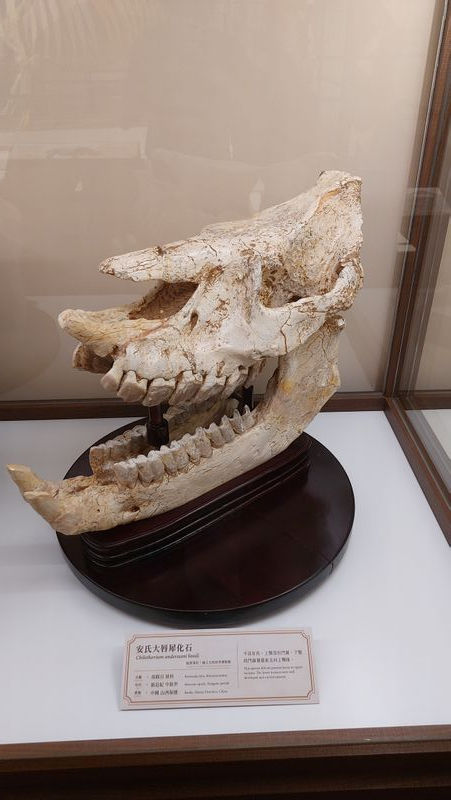
The Odd “Underbite” Appearance of Chilotherium
The genus Chilotherium was a group of large rhinoceroses that flourished from the Miocene to the Pliocene. It belonged to the subfamily Aceratheriinae, a lineage of rhinoceroses that lacked the keratin horns typical of modern species.
Instead of horns, Chilotherium possessed a dramatic pair of lower incisors that projected forward like tusks, somewhat reminiscent of those of elephants. These enlarged teeth gave the animal a striking underbite appearance. Scientists have proposed several possible functions for these tusks, but the most widely accepted explanation relates to sexual selection. The tusks may have been used in combat between males during mating competition, while also serving as visual signals that attracted potential mates.

The unusual anatomy of Chilotherium was not limited to its teeth. Its lifestyle appears to have differed substantially from that of modern rhinoceroses as well. Rather than inhabiting open grasslands, this animal likely lived in environments similar to those preferred by modern tapirs—wetlands, marshes, and forest margins.
Evidence from skull fossils suggests that Chilotherium probably possessed two flexible lips. These soft, mobile lips would have served multiple purposes. They could shield the protruding tusks from damage while also functioning as precise feeding tools. With them, the animal could grasp aquatic vegetation growing in marshy environments or pluck tender leaves from plants along riverbanks.

How Do Paleontologists Know Chilotherium Was a Rhinoceros?
Given its hornless skull, unusual tusks, and specialized ecology, Chilotherium might seem quite different from the rhinoceroses we recognize today. How, then, do paleontologists confidently identify it as a member of the rhinoceros family?
The key lies in the teeth—particularly the molars. Rhinoceroses possess a distinctive molar pattern characterized by a complex folded structure formed by enamel and dentine. This folding creates a unique grinding surface that increases the durability of the teeth and helps them resist rapid wear from constant chewing.
Among mammals, the shapes and patterns of molar surfaces vary significantly between groups. These patterns are therefore extremely useful for identifying evolutionary relationships. In the case of Chilotherium, the structure of its molars clearly places it within the rhinoceros lineage despite its unusual outward appearance.
Origins and Expansion of the Tusked Rhinoceroses
Most researchers believe that the ancestors of Chilotherium originated in the southern regions of Eurasia, particularly in what is now the Siwalik region of South Asia. Their lineage likely emerged during the middle Miocene.
During that time, warm and humid climatic conditions allowed these animals to expand across large areas. Fossils show that they spread widely across Eurasia, reaching regions that are now part of China, Mongolia, and Russia. By the late Miocene, Chilotherium had dispersed across much of the Eurasian continent.
Throughout this long period of expansion, the genus diversified into multiple species. At least three distinct species are known, and in many regions these animals became dominant large herbivores within their ecosystems.

Climate Change and the Decline of Chilotherium
Like many evolutionary stories, however, the history of Chilotherium eventually approached an end. Geological changes began to reshape the planet's climate. The uplift of the Himalayas altered atmospheric circulation and contributed to the onset of cooler and drier conditions. Over time, Earth entered a sequence of glacial cycles.
As climates shifted, landscapes changed dramatically. Wet environments gradually gave way to expanding grasslands. The marshy habitats and aquatic plants that had supported Chilotherium began to disappear.
This transition posed a serious challenge. Unlike some other herbivores, Chilotherium did not evolve the dental adaptations necessary for efficiently chewing coarse grasses. When grasslands dominated by grasses began to spread, these animals found themselves poorly equipped to exploit the new vegetation.
Competition from New Rhinoceroses
Environmental stress alone was not the only problem facing Chilotherium. At roughly the same time that their habitats were changing, another lineage of rhinoceroses was expanding into Eurasia from Africa. These newcomers were the ancestors of modern rhinoceroses.
Compared with Chilotherium, these rhinoceroses were better adapted to open grassland environments. Their ecological flexibility allowed them to thrive under the new climatic conditions. As they spread, they competed with Chilotherium and other herbivores for resources.
The arrival of these more adaptable grazers further compressed the ecological space available to Chilotherium. Already struggling with environmental change, the tusked rhinoceroses could not compete effectively.
By the early Pliocene, the lineage disappeared entirely. These once distinctive rhinoceroses vanished from the fossil record, leaving only scattered remains in the sediments of Eurasia's ancient landscapes.
Echoes of an Ancient Lineage
Although Chilotherium itself is long gone, its evolutionary story remains preserved in the fossil record. Like many extinct rhinoceroses, its disappearance did not mark the end of the rhinoceros family.
Millions of years later, other members of the lineage continue to survive. Modern rhinoceroses—though fewer in number than in the past—still carry forward the evolutionary legacy of their ancestors. In their bodies, behaviors, and ecological roles, they continue a long biological narrative that stretches deep into Earth's history.
Through them, the story of rhinoceroses—past, present, and future—continues to unfold.
Author: Rodrigo
References:
Rivals, Florent; Belyaev, Ruslan I.; Basova, Vera B.; Prilepskaya, Natalya E. (15 May 2024). "A tale from the Neogene savanna: Paleoecology of the hipparion fauna in the northern Black Sea region during the late Miocene". Palaeogeography, Palaeoclimatology, Palaeoecology.
Cerdeño, Esperanza. (1998). Diversity and evolutionary trends of the family Rhinocerotidae (Perissodactyla). Palaeo. 141 (1–2): 13–34.


Comments