
Giganotosaurus carolinii


Age
Cretaceous(Albian-Cenomanian)
112-110 Ma
Taxonomy
Kingdom: Animalia
Phylum: Chordata
Class: Sauropsida
Superorder: Dinosauria
Order: Saurischia
Suborder: Theropoda
Family: Carcharodontosauridae
Genus: Giganotosaurus
Species: Giganotosaurus carolinii
Morphological description
Giganotosaurus carolinii was an extremely large theropod dinosaur characterized by a proportionally low and elongate skull, a reduced pectoral girdle, robust vertebrae, and powerful hind limbs. The maxilla was long and high, with a dorsoventrally broad main body and nearly parallel dorsal and ventral margins. It possessed a pronounced subnarial process and a small, elliptical maxillary fenestra. The lacrimal bore a rugose crest directed posterodorsally, while the jugal process of the postorbital projected anteroventrally into the orbit. The quadrate was dorsoventrally elongate and had two pneumatic foramina on its medial surface. The anterior end of the dentary was dorsoventrally expanded, with a flattened symphysial surface and a ventral process, forming part of the diagnostic character combination of the species.
One specimen, MUCPv-95, preserves a dentary 61 cm long, although its posteriormost portion is missing, and contains 15 preserved alveoli. The dentary symphysis is approximately 18 cm high, and the ventral margin is concave. Beginning around the ninth to tenth alveolus, the dentary curves markedly inward toward the symphyseal region, indicating that the paired mandibles would have formed a relatively wide mouth. The teeth are laterally compressed and oval in cross-section, with serrated anterior and posterior carinae. Fused interdental plates occur on the medial surface of the dentary, while longitudinal grooves associated with nutrient foramina are present on both the lateral and medial surfaces.
In the holotype, MUCPv-CH-1, the neck was strong and powerful. The axis had a robust centrum and odontoid process, while the posterior cervical vertebrae had short centra with pleurocoels subdivided by a lamina. The dorsal vertebrae had high neural arches and deep pleurocoels, and the caudal vertebrae possessed robust centra with posterodorsally elongate neural spines. The pectoral girdle was proportionally small, with a scapula less than half the length of the femur. The scapula bore a prominent tubercle for insertion of the triceps, whereas the coracoid was small and hook-shaped. The ilium had a convex dorsal margin, the pubis possessed a well-developed pubic foot, and the ischium was straight and distally expanded. In lateral view, the femur was slightly sigmoidal and had an extremely robust head and a large, proximally positioned fourth trochanter. The proximal end of the tibia was expanded.
The posterior region of the skull of the holotype MUCPv-CH-1 had a broad frontoparietal region forming an overhanging shelf that partially covered the supratemporal fenestra. The parietal lacked a distinct sagittal crest, although the nuchal crest and supraoccipital region were strongly developed. The supraoccipital formed a large median prominence, while the occipital condyle was extremely broad and low. Most sutures of the braincase were fused, indicating that the holotype represented a mature individual. The endocranial cast had a volume of approximately 275 ml, of which the region extending from the narrowest constriction of the olfactory tracts to the exit of the hypoglossal nerve accounted for approximately 225 ml. The region occupied by the olfactory bulb cavities and olfactory tracts was elongate, and the olfactory tracts themselves were robust. The root of cranial nerve V was relatively large. Cranial nerves IX and X left the endocranial cavity together, cranial nerve XI initially exited through a separate opening before joining IX and X, and all branches of cranial nerve XII passed through a single internal opening. These features distinguish Giganotosaurus from Carcharodontosaurus.

Etymology
The generic name Giganotosaurus is derived from gigan, meaning "giant"; notos, meaning "southern"; and saurus, meaning "reptile."
The specific name carolinii honors Rubén Darío Carolini, the Argentine amateur fossil hunter who discovered the holotype. In 1993, he found the specimen near Villa El Chocón in Neuquén Province, Argentina.
Biological description
The holotype of Giganotosaurus carolinii, MUCPv-CH-1, was discovered in 1993 in Neuquén Province, Patagonia, Argentina. It consists of a disarticulated but relatively well-preserved skeleton, including a partial skull, most of the vertebral column, complete pectoral and pelvic girdles, both femora, and the left tibia and fibula. The locality lies approximately 15 km south of Villa El Chocón, in the Candeleros Member of the Río Limay Formation, which under the stratigraphic framework used at the time was assigned an Albian–Cenomanian age. Extensive fusion among the bones of the braincase further indicates that the holotype represented a mature individual.
When formally named in 1995, Giganotosaurus carolinii was estimated to have reached approximately 12.5 m in total length and to have weighed about 6–8 tonnes. It was described as the largest theropod then known from the Southern Hemisphere and was even regarded as a possible candidate for the largest known predatory dinosaur. The original study estimated a skull length of approximately 1.53 m and a femoral length of 1.43 m, making the femur about 5 cm longer than that of the famous Tyrannosaurus rex specimen "Sue." On the basis of the robustness of its bones, the authors also suggested that the holotype may have been heavier than Sue. A 2002 study of the braincase adopted more conservative dimensions, citing an estimated skull length of about 1.6 m, a femoral length of 1.43 m, a tibial length of 1.12 m, and a minimum total body length of approximately 12 m.
A second specimen, MUCPv-95, further complicated the early debate over the largest known theropod. This isolated left dentary had actually been discovered in 1987 at Cerro Los Candeleros in Argentina, approximately 35 km southwest of Plaza Huincul, and likewise came from the red sandstones of the Candeleros Member. Its overall morphology closely matches that of the holotype dentary, with both specimens sharing a squared anterior end, a flattened symphysial surface, and an anteroventral process. This distinctive combination supported its referral to Giganotosaurus carolinii. The dentary of MUCPv-95 was approximately 8% larger than that of the holotype. A 1998 study adopted an estimated holotype skull length of 180 cm and, by scaling the new specimen upward by 8%, proposed that MUCPv-95 may have had a skull approximately 195 cm long. On this basis, it was described at the time as the largest theropod specimen yet known. The 195 cm estimate was a proportional extrapolation made in that early study and is therefore best retained as part of the historical record of size estimates for the species.
MUCPv-95 also preserves information on tooth replacement. At the stage of preparation described in the study, only alveoli 4, 8, and 9 contained functional teeth. Tooth 7 was in an advanced stage of eruption, while teeth 1, 5, 10, and 12 were at earlier stages of eruption. This pattern indicates continuous, staggered tooth replacement along the lower jaw. With the exception of the first alveolus, which was smaller, the preserved alveoli were broadly similar in size.
The original 1995 phylogenetic analysis placed Giganotosaurus within Tetanurae on the basis of features of the tibia, fibula, astragalus, lacrimal, pubis, and femur, and considered it more closely related to what was then termed Neotetanurae than to certain more basal large theropods. At the same time, retention of more primitive features of the ischium and astragalus excluded it from Coelurosauria. Subsequent studies placed Giganotosaurus within Carcharodontosauridae. A 2002 phylogenetic analysis based on the braincase further supported a close relationship between Giganotosaurus and the African genus Carcharodontosaurus, with several shared derived braincase characters supporting the monophyly of Carcharodontosauridae. A 2010 study of the cranial endocast likewise found the endocranial morphology of Giganotosaurus to be very similar to that of Carcharodontosaurus. By comparison, Acrocanthosaurus showed more substantial differences in both endocast and braincase morphology.
Carcharodontosaurids may also have differed mechanically from tyrannosaurids in the organization of the jaw apparatus. Tyrannosaurids tended to increase the transverse mass of the jaw musculature, thereby increasing bite force. In Giganotosaurus and its close relatives, the jaw articulation was displaced farther posteriorly, increasing the length of portions of the jaw musculature. The study suggested that this arrangement may have favored faster jaw closure. The skull of Giganotosaurus therefore combined a broad gape, elongate jaw muscles, and powerful cranial and cervical musculature into a distinctive predatory apparatus.
A 2001 biomechanical study examined the potential running ability of Giganotosaurus. On the basis of femoral bone strength alone, its strength indicator was estimated at approximately 7 GPa⁻¹, far below the approximately 44 GPa⁻¹ calculated for the ostrich, apparently suggesting limited cursorial capability. For an animal weighing several tonnes, even a fall at relatively low speed could potentially have caused severe or fatal injuries. The authors pointed out, however, that the femur of a running bird is held nearly horizontally, whereas non-avian theropods possessed a massive tail that positioned the center of mass closer to the hip joint. The mechanical loading of the femur would therefore have differed substantially from that of an ostrich, making simple comparisons based on femoral strength in ostriches or humans of limited value.
The study consequently developed a kinematic model centered on the time available for recovery of body equilibrium. The model compared the time available while the supporting limb moved backward beneath the body with the time required for the opposite limb to swing forward far enough to restore support. As locomotor speed increased, progressively less time remained for the animal to regain equilibrium. The researchers also reconstructed the femoral protractor musculature on the basis of previous studies of theropod pelvic musculature and estimated limb excursion using muscle cross-sectional area, lever arms, hindlimb mass distribution, and moment of inertia. Using a body mass of 9,000 kg for Giganotosaurus, the model yielded a maximum speed of approximately 14 m/s, equivalent to about 50 km/h. Stability declined continuously as speed increased, with approximately 14 m/s representing the threshold at which the opposite hind limb could still be brought forward quickly enough to restore equilibrium. Under this model, Giganotosaurus may therefore have possessed considerable running ability, with an estimated maximum speed comparable to values inferred for much smaller theropods from trackways.
Floodplain deposits of the Candeleros Member that yielded Giganotosaurus carolinii also contain abundant sauropod remains. The 1995 description mentioned the approximately 13-m-long basal titanosaur Andesaurus delgadoi and an unnamed sauropod then regarded as diplodocid-like. The substantially larger Argentinosaurus huinculensis, however, came from the stratigraphically higher Huincul Member of the Río Limay Formation and therefore did not occur at the same stratigraphic level as Giganotosaurus.
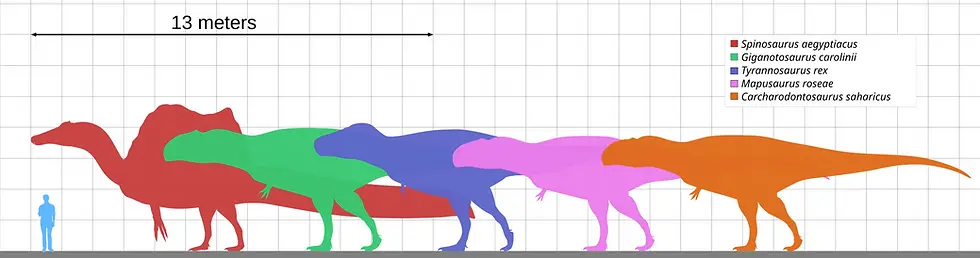
(Author: Shui-Ye You)
References
Blanco RE and Mazzetta GV. (2001). A new approach to evaluate the cursorial ability of the giant theropod Giganotosaurus carolinii. Acta Palaeontologica Polonica.
Calvo JO and Coria RA. (1998). New specimen of Giganotosaurus carolinii (Coria & Salgado, 1995), supports it as the largest theropod ever found. GAIA.
Carabajal AP and Canale JI. (2010). Cranial endocast of the carcharodontosaurid theropod Giganotosaurus carolinii CORIA & SALGADO, 1995. Neues Jahrbuch für Geologie und Paläontologie – Abhandlungen.
Coria RA. (2009). The braincase of Giganotosaurus carolinii (Dinosauria: Theropoda) from the Upper Cretaceous of Argentina. Journal of Vertebrate Paleontology.
Coria RA and Salgado L. (1995). A new giant carnivorous dinosaur from the Cretaceous of Patagonia. Nature.


Comments